Prolotherapy
Prolotherapy is a regenerative injection treatment that harnesses your body's natural healing ability to repair damaged joints, tendons and ligaments.
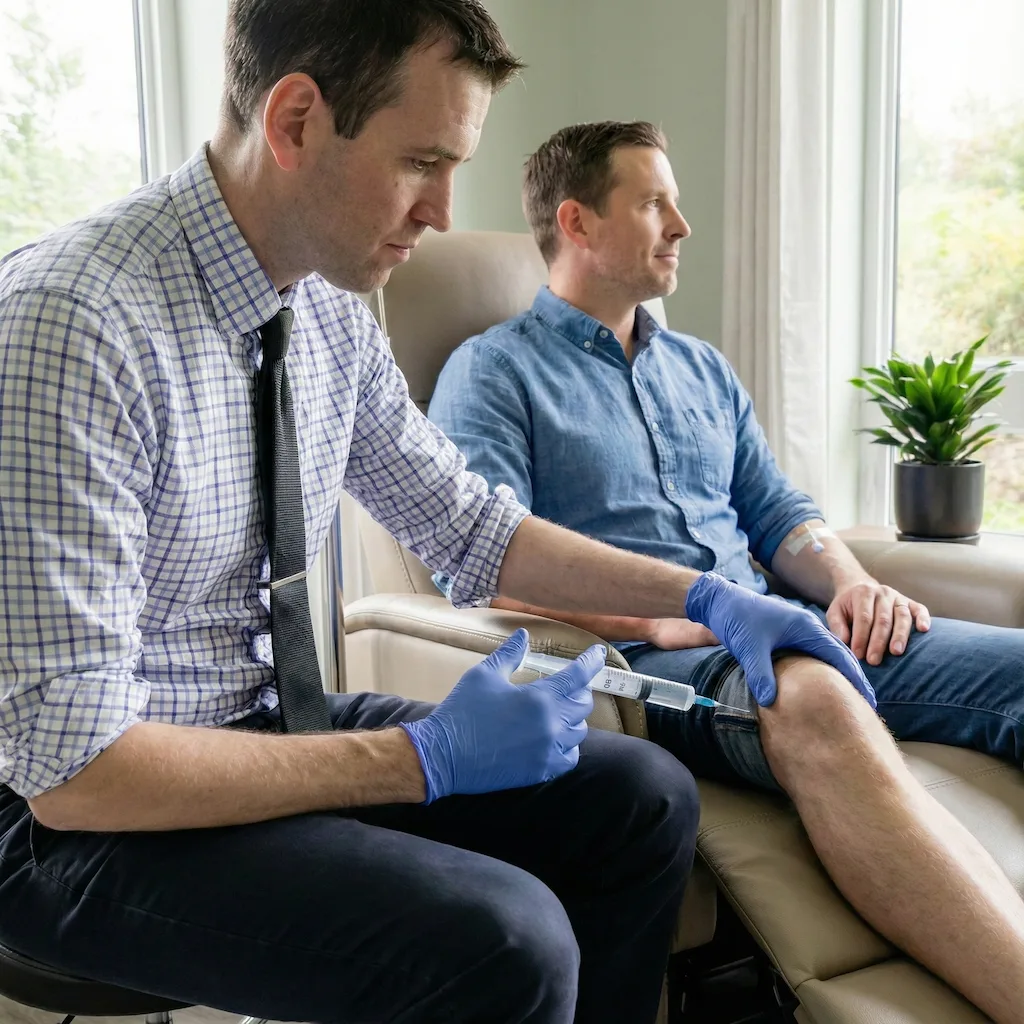
What is Prolotherapy?
Prolotherapy, short for "proliferative therapy," is an injection treatment that stimulates the body's natural healing response. A solution of concentrated dextrose is injected into damaged or weakened connective tissue, triggering a controlled inflammatory response that initiates tissue repair and regeneration.
This technique has been used since the 1930s, when George Hackett, MD, developed it as a treatment for ligament and joint pain. Over the decades, prolotherapy has been refined and studied extensively, with dozens of clinical trials demonstrating its effectiveness for various musculoskeletal conditions.
Unlike cortisone injections, which suppress inflammation and can weaken tissue over time, prolotherapy works with your body's natural healing mechanisms to strengthen and repair damaged structures. This makes it particularly valuable for chronic conditions where the goal is lasting repair rather than temporary symptom relief.
How Prolotherapy Works
Injection
A solution of concentrated dextrose (typically 12.5-25%) is injected directly into the damaged tissue; whether that's a joint capsule, tendon attachment or ligament.
Healing Response
The hypertonic solution triggers a controlled inflammatory response that activates growth factors including platelet-derived growth factor (PDGF), transforming growth factor-beta (TGF-β) and fibroblast growth factor.
Tissue Repair
Over the following weeks, fibroblasts lay down new collagen, strengthening the damaged tissue. Multiple treatments build upon each other, progressively improving tissue integrity.
Conditions We Treat with Prolotherapy
Prolotherapy has been studied in clinical trials for numerous musculoskeletal conditions. Click on each condition to learn more about the research and treatment approach.
Osteoarthritis
16 clinical trials support prolotherapy for osteoarthritis, particularly knee OA. Studies show significant improvements in pain, stiffness and range of motion with effects lasting years.
Learn moreTendon Injuries
Strong evidence supports prolotherapy for tennis elbow, plantar fasciitis and Achilles tendinopathy. Meta-analyses show meaningful improvements in pain and function.
Learn moreBack & Sacroiliac Pain
Prolotherapy shows particularly strong results for sacroiliac joint pain, with one study finding 58.7% maintained relief at 15 months compared to only 10.2% with steroid injection.
Learn moreOsgood-Schlatter Disease
A landmark study in PEDIATRICS showed 84% of young athletes with recalcitrant Osgood-Schlatter achieved asymptomatic sport at one year following prolotherapy treatment.
Learn moreResearch Evidence
Meta-analyses have confirmed prolotherapy's effectiveness for lateral epicondylitis (tennis elbow) and plantar fasciitis, with improvements exceeding the minimal clinically important difference; the threshold that indicates a real, meaningful improvement for patients.
What to Expect
Initial Consultation
We'll review your condition, examine the affected area and discuss whether prolotherapy is appropriate for you. We'll explain the treatment process and answer any questions.
Treatment Sessions
Most conditions require 4-6 treatment sessions, spaced 1-2 weeks apart. Each session involves one or more small injections into the affected tissue. Treatments typically take 20 minutes or less.
Recovery
You may experience some soreness for 1-3 days after treatment; this is a normal part of the healing response. Most patients can continue normal activities.
Results
Improvement is typically gradual, with benefits accumulating over the treatment series. Many patients notice improvement by the third or fourth treatment. The longest published study (2.5 years) showed continued improvement throughout the entire study period.
Safety Profile
Prolotherapy has an excellent safety record. The dextrose solution is simple sugar mixed with a local anesthetic, the same substances your body uses for energy and that are commonly used in medical procedures.
Common temporary effects:
- Mild to moderate soreness at injection sites (1-3 days)
- Temporary stiffness in the treated area
- Minor bruising
Serious complications are rare. In the published clinical trials involving hundreds of patients, no serious adverse events have been reported with dextrose prolotherapy.
Related Treatments
We offer several variations of regenerative injection therapy to address different conditions and patient needs.
Prolotherapy for Arthritis
Focuses on degenerative joint pain and ligament laxity with dextrose-based regenerative injection therapy.
Learn moreNeural Prolotherapy
Uses very dilute dextrose (5%) injected along superficial nerves to treat neurogenic inflammation and chronic pain conditions including neuropathy and complex regional pain.
Learn moreFrequently Asked Questions
Is prolotherapy painful?
The injections cause brief, mild discomfort. We use a local anesthetic (lidocaine) mixed with the dextrose solution to minimize pain during the procedure. Most patients describe it as a tolerable pressure or aching sensation. After treatment, you may experience soreness similar to a workout for 1-3 days.
How many treatments will I need?
Most conditions respond well to 4-6 treatment sessions, spaced 1-2 weeks apart. Some patients notice improvement after the first treatment, though the full benefit typically develops over the course of the treatment series. Chronic or severe conditions may require additional sessions.
Can I take pain medication after treatment?
Avoid NSAIDs for 24 hours unless necessary for pain control. Acetaminophen is fine.
Is prolotherapy covered by insurance?
MSI does not cover prolotherapy. Most private health insurance plans do. We offer direct billing for many major insurers.
How does prolotherapy compare to cortisone injections?
Cortisone injections reduce inflammation and provide quick pain relief, but this relief typically fades over weeks to months and repeated injections can weaken tissue. Prolotherapy takes longer to work (it's stimulating a healing process), but the goal is lasting tissue repair. For sacroiliac joint pain, one study found prolotherapy provided sustained relief in 58.7% of patients at 15 months compared to only 10.2% with steroid injection.
Who is not a good candidate for prolotherapy?
Prolotherapy may not be appropriate for people with active infections, certain bleeding disorders or those taking blood thinners. It's also not recommended for complete tendon or ligament tears that require surgical repair. During your consultation, we'll review your medical history to ensure prolotherapy is safe and appropriate for you.
Key References
- Hauser RA, et al. A systematic review of dextrose prolotherapy for chronic musculoskeletal pain. Clin Med Insights Arthritis Musculoskelet Disord. 2016;9:139-159.
- Rabago D, et al. Dextrose prolotherapy for knee osteoarthritis: a randomized controlled trial. Ann Fam Med. 2013;11(3):229-237.
- Zhu M, et al. Effects of Hypertonic Dextrose Injection (Prolotherapy) in Lateral Elbow Tendinosis: A Systematic Review and Meta-analysis. Arch Phys Med Rehabil. 2022;103(11):2209-2218.
- Lai CC, et al. Efficacy of prolotherapy for plantar fasciitis: A systematic review and meta-analysis. Medicine (Baltimore). 2021;100(51):e28216.
- Kim WM, et al. A randomized controlled trial of intra-articular prolotherapy versus steroid injection for sacroiliac joint pain. J Altern Complement Med. 2010;16(12):1285-1290.
- Topol GA, et al. Hyperosmolar dextrose injection for recalcitrant Osgood-Schlatter disease. Pediatrics. 2011;128(5):e1121-e1128.
Ready to Start Your Healing Journey?
Schedule a consultation to discuss whether prolotherapy is right for your condition. We'll review your health history, examine your injury and create a personalized treatment plan.
Book Online