On This Page
What Is Neural Prolotherapy?
Neural prolotherapy is a treatment for pain which uses shallow injections of a 5% dextrose (sugar) solution into the surrounding area of an inflamed nerve. The goal of the treatment is to reduce inflammation, swelling and pain of the affected nerve.
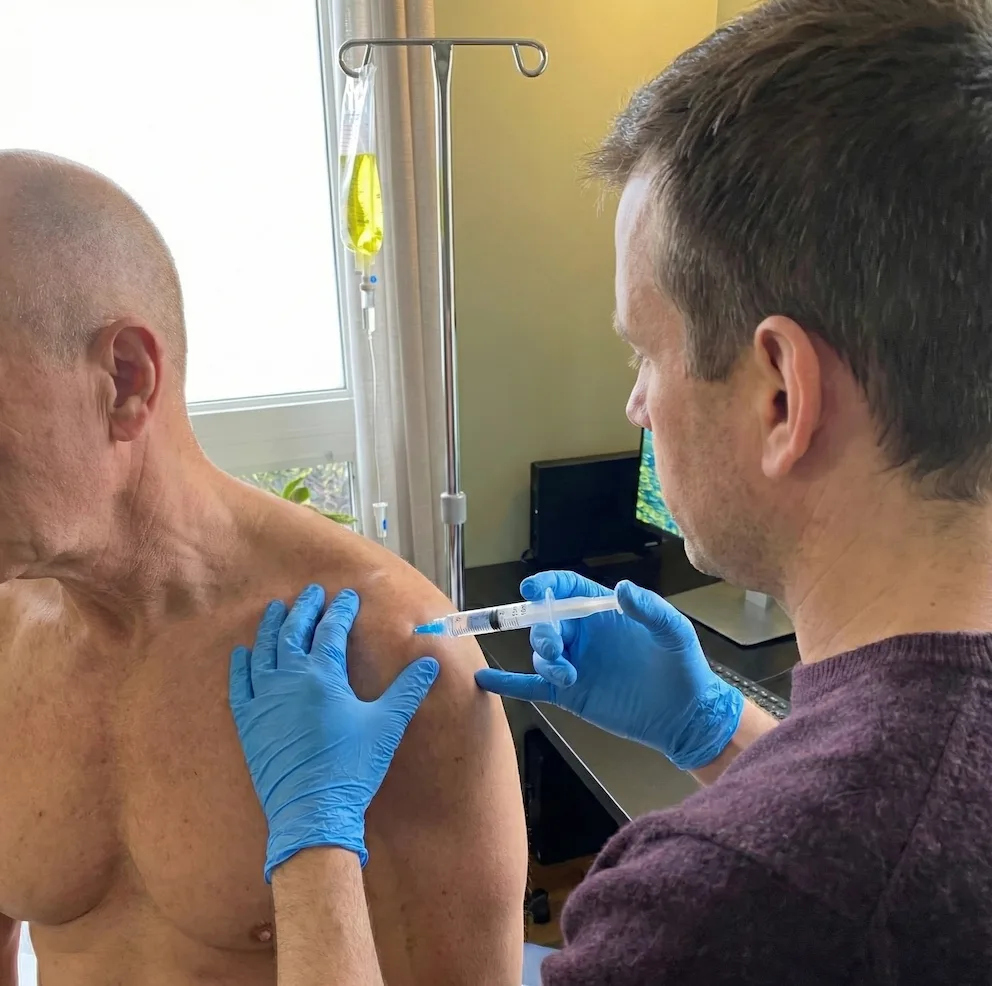
This treatment was originated by Dr. John Lyftogt MD of New Zealand in an attempt to remedy his own Achilles tendinitis. Following his recovery, Dr. Lyftogt has since gone on to a career of teaching neural prolotherapy internationally.
What Causes Pain?
The perception of pain begins in the peripheral sensory nerves of the body. When the TRPV-1 receptor (aka: capsaicin receptor) of sensory nerve fibers is activated, internal changes occur1. As inflammatory changes progress in the nerve, swelling and internal pressure increase. Internal nerve “flow” is slowed by this process and will even come to a halt at a pressure of approximately 30mmHg2. New injuries, old injuries and overuse are all contributing factors to excessive activation of the neural TRPV-1 receptor, nerve compression, inflammation and pain.
What Has Neural Prolotherapy Been Studied For?
Perineural dextrose injection has been studied for selected peripheral nerve and musculoskeletal pain conditions, but evidence varies substantially by diagnosis and technique. Findings from one condition cannot establish that it is appropriate for another, and symptoms alone do not determine candidacy.
Why Dextrose Injections For Pain?
The theory behind using 5% dextrose for pain is that dextrose is a direct antagonist of the TRPV-1 receptor. When injected near an inflamed, swollen nerve it is thought that the dextrose downregulates activity of the TRPV-1 receptors and reduces inflammation and pain as a result. The injected fluid also creates a hydrodissection, surrounding the nerve and creating a cushion from any impinging muscles or bursae which may be squeezing the nerve.
Is Neural Prolotherapy Similar to Acupuncture?
Yes, in some ways. Neural prolotherapy is similar to acupuncture in that the needles used are of similar size and the goal is often the same, that is, to reduce pain. The primary difference is that neural prolotherapy has an additive effect from the injection of 5% dextrose into the tissue which is not accomplished with the needle-stick alone of acupuncture.
Do Neural Prolotherapy Injections Hurt?
Discomfort varies by location, technique and individual sensitivity. Pain, bruising, bleeding, infection, nerve injury and other anatomical-area-specific complications are part of the consent discussion.
Are Neural Prolotherapy Injections Safe?
No injection is risk-free. Safety depends on the diagnosis, anatomical area, technique, sterility, formulation, clinician authorization and individual health. The fact that dextrose is also present in food does not establish injection safety.
How Will I Feel After a Neural Prolotherapy Session?
Response is uncertain. Short-term change after an injection does not establish durable benefit, and some people may not improve.
How Is Treatment Planned?
There is no general treatment count or interval appropriate for website readers. Whether a procedure is offered or repeated depends on the diagnosis, evidence, response, risks and alternatives.
Has Neural Prolotherapy Been Researched?
The research remains limited. One small trial compared dextrose with saline and lidocaine for myofascial trigger points,3 while much of the broader literature concerns different prolotherapy concentrations, techniques and conditions. Those studies cannot be treated as direct evidence for every use of perineural injection.
Neural Prolotherapy in Halifax
If you are interested in having neural prolotherapy treatment and are in the Halifax area, contact Dr. Colin MacLeod, ND to book an initial consultation with Dr. MacLeod.
References
- Caterina MJ, Schumacher MA, Tominaga M, Rosen TA, Levine JD, Julius D. The Capsaicin receptor: A heat-activated ion channel in the pain pathway. Nature 1997; 389:816-824
- Magdesian MH, Sanchez FS, Lopez M, Thostrup P, Durisic N, Belkaid W, Liazoghli D, Grütter P, Colman DR. Atomic force microscopy reveals important differences in axonal resistance to injury. Biophys J. 2012 Aug 8;103(3):405-14.
- Kim MY, Na YM, Moon JH. Comparison on Treatment Effects of Dextrose Water, Saline and Lidocaine for Trigger Point Injection. J Korean Acad Rehabil Med. 1997 Oct;21(5):967-973.
- Scarpone M, Rabago DP, Zgierska A, Arbogast G, Snell E. The efficacy of prolotherapy for lateral epicondylosis: a pilot study. Clin J Sport Med. 2008 May;18(3):248-54.
- Distel LM, Best TM. Prolotherapy: a clinical review of its role in treating chronic musculoskeletal pain. PM R. 2011 Jun;3(6 Suppl 1):S78-81.